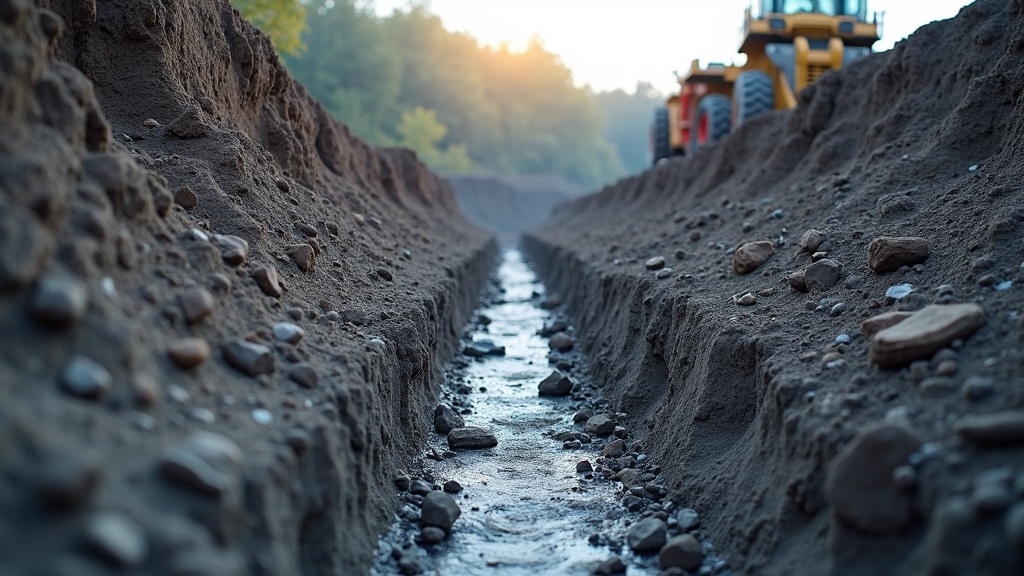
Learn how understanding backfill grouting in mining improves ground support, reduces subsidence, and enhances safety underground. Explore methods, materials, and real-world applications.
Table of Contents
- Key Takeaway
- By the Numbers
- Introduction
- What Is Backfill Grouting in Mining?
- Materials and Mix Design for Backfill Grouting
- Application Methods in Underground Operations
- Environmental and Operational Benefits
- Important Questions About Understanding Backfill Grouting in Mining
- Comparison of Backfill Strategies
- Practical Tips
- The Bottom Line
- Further Reading
Key Takeaway: Understanding backfill grouting in mining is essential for stabilizing underground voids, preventing surface subsidence, and improving safety. This article covers definitions, materials, methods, and the environmental advantages of modern grouting backfill techniques in mining and tunneling.
By the Numbers
- Typical backfill grouting pressure: 0.5 psi per foot of depth (U.S. Bureau of Mines, 1993).[1]
- Common cement–fly ash mix ratio: 1 part cement to 3–9 parts sand or fly ash (U.S. Bureau of Mines, 1993).[1]
- Compressive strength of bulk mine-fill grouting: ~1.0 N/mm² (Keller Group, 2023).[2]
- Working face advances in 10 m increments during pipeline backfill grouting in coal mines (NCBI, 2017).[3]
Introduction
Understanding backfill grouting in mining is critical for engineers and operators who manage underground stability. As extraction depths increase and surface structures become more vulnerable, the need for reliable void-filling techniques has never been greater. Backfill grouting involves injecting a cementitious slurry into mined-out areas, bed separations, or abandoned workings to create a consolidated mass that supports the surrounding rock mass. This article aims to provide a comprehensive overview of the methods, materials, and practical considerations involved. Whether you’re new to the field or looking to update your knowledge, this guide covers the essentials of backfill grouting in mining and tunneling.
What Is Backfill Grouting in Mining?
Backfill grouting refers to the process of pumping a fluid mixture – typically composed of cement, water, and fine aggregates – into underground voids created by mining activities. The primary goal is to restore ground stability and prevent collapse or subsidence at the surface. As researcher Wei Sun explains, Backfill grouting of the caving rock mass prior to compaction strengthens the caving rock and supports the overlying strata, thereby slowing down surface subsidence in coal mining areas.
[3] This statement underscores the proactive role grouting plays in strata control.
The technique is especially valuable in coal mining and metal mining where large cavities remain after extraction. By filling these voids with a material that hardens over time, the natural load-bearing capacity is partially restored. Additionally, grouting can be used to fill the annular gap between tunnel linings and the surrounding ground, preventing water ingress and subsidence in high-traffic areas. For a deeper dive into specific practices, refer to our backfillgrouting guide.
Origins and Typical Applications
Historically, backfilling was done with dry waste rock, but modern techniques rely on hydraulic grouts that can reach remote or irregular cavities. Typical applications include filling abandoned mine workings, stabilizing goaf areas in longwall mining, and reinforcing pillars. According to mining engineer Michael T. Snyder, The support capacity of grout‑stabilized backfill is considered to be very good, and grouting is used regularly as a backfill method in small areas of abandoned mine workings.
[1] The process integrates well with other ground support measures and is adaptable to different geological conditions.
Materials and Mix Design for Backfill Grouting
The choice of materials directly affects the strength, pumpability, and cost of backfill grouting. Most recipes use Portland cement as the primary binder, combined with fine aggregates or pozzolanic materials such as fly ash. Common mix proportions for cement–fly ash grout range from 1 part cement to 3–9 parts sand or fly ash (U.S. Bureau of Mines, 1993).[1] This flexibility allows engineers to tailor the grout to site-specific conditions, such as void size, water table, and required strength.
Water content is carefully controlled. In fly‑ash slurry backfill grouting for coal mines, a typical proportion is 8 parts water to 10 parts fly ash by mass (NCBI, 2017).[3] Such mixtures are inexpensive and reliable for stabilizing abandoned voids. More advanced formulations may include chemical admixtures to accelerate setting time or improve flow characteristics. The target compressive strength for bulk mine-fill grouting is often around 1.0 N/mm² (Keller Group, 2023).[2] Recent studies have also explored using recycled glass waste as an aggregate, providing a dual benefit of waste disposal and ground support.
When selecting materials, consider the long-term durability. Sulfate attack and groundwater chemistry can degrade cementitious grouts over time. In such cases, adding pozzolans or using alternative binders may be necessary. For more information on material selection, see our post on foundation backfill which covers similar principles for surface applications.
Application Methods in Underground Operations
Applying backfill grouting requires careful planning of borehole placement, injection pressure, and flow rates. Borehole diameters typically range from 2 to 6 inches for pumping quick‑setting, low‑slump grout into small mine voids (U.S. Bureau of Mines, 1993).[1] The grout is delivered using piston pumps or progressing cavity pumps that can handle abrasive slurries. In coal mines, the pipeline backfill process often advances in 10 m increments before the filling sequence of branch pipes is repeated (NCBI, 2017).[3]
Pressure grouting is common when filling abandoned workings. Pressure is kept low (around 0.5 psi per foot of depth) to avoid fracturing the surrounding rock. In larger voids, bulk mine-fill techniques use higher volumes and lower pressures to fill the cavity economically. Modern operations increasingly rely on real-time monitoring and AI-driven grout optimization techniques to adjust mix and flow on the fly. These tools improve consistency and reduce waste.
Tunneling applications require grouting the annular gap behind segmental linings immediately after excavation. This prevents soil relaxation and surface settlement. The grout must be designed to set quickly yet remain pumpable for the duration of the operation. In all cases, proper quality control – including sampling, slump testing, and unconfined compressive strength tests – ensures the grout performs as intended.
Environmental and Operational Benefits
Understanding backfill grouting in mining reveals significant environmental advantages. By filling voids, grouting reduces the risk of surface subsidence that can damage infrastructure and ecosystems. It also allows mining companies to extract resources more completely while maintaining stability. As Professor Shimin Liu notes, As a green mining technique, grouting backfill is designed to fill mining-induced overburden bed separations and mined-out areas with caving rocks, providing an efficient strategy to control strata movement and surface subsidence caused by underground mining.
[4] This approach aligns with sustainable mining practices and helps companies meet regulatory requirements.
Operationally, backfill grouting creates a safer working environment. Filled voids eliminate the risk of sudden collapse and reduce rock bursts in deep mines. Additionally, stabilized ground allows for easier transportation and equipment movement. The cost of grouting is often justified by the prevention of damage to surface buildings, roads, and utilities. Moreover, using industrial by‑products like fly ash in grout reduces the environmental footprint of both mining and power generation.
Ongoing research explores even more eco‑friendly materials. For example, using glass waste slurries as backfill not only stabilizes underground openings but also diverts waste from landfills. A project led by Aditya Kumar notes that Grout and slurry backfilling in mines and tunnels not only stabilises collapsing underground openings and prevents surface subsidence in high‑use areas, but also provides a dual function as both a structural support system and a working platform for future operations.
[5] This dual purpose makes backfill grouting a versatile tool in modern mining.
Important Questions About Understanding Backfill Grouting in Mining
How does backfill grouting differ from conventional grouting?
Conventional grouting typically fills cracks and fissures for water sealing or soil stabilization, while backfill grouting specifically aims to fill large underground voids created by mining. The scale and material volumes are much larger, and the structural requirements are focused on supporting overlying rock mass rather than just sealing. Backfill grouting often uses economical materials like fly ash and sand mixed with cement to achieve bulk strength.
What is the typical compressive strength required for mine backfill?
For bulk mine-fill grouting, a common target is about 1.0 N/mm² (Keller Group, 2023).[2] However, requirements vary depending on the depth, stress conditions, and whether the fill is exposed to dynamic loads. Some applications may need higher strengths, especially in pillars or areas subject to blasting. The mix design can be adjusted by increasing cement content or using additives to achieve the desired strength.
Can backfill grouting be used in active mines?
Yes, backfill grouting is often integrated into the mining cycle. In cut‑and‑fill mining, stopes are filled shortly after ore removal to provide a working platform for the next level. In longwall mining, goaf grouting can be done while the face advances. The key is to coordinate grouting with excavation schedules to avoid delays. Real‑time monitoring and automated systems help manage this integration effectively.
What are the main risks when using backfill grouting?
Risks include insufficient filling (voids left ungrouted), grout washout in high groundwater flow, and chemical attack on the grout. Over‑pressurization can fracture the surrounding rock or break through to the surface. Proper site investigation, quality control, and experienced contractors mitigate these risks. Regular sampling and strength testing ensure the grout meets design specifications.
Comparison of Backfill Strategies
Different mining scenarios call for different backfill approaches. The table below compares three common methods used in underground operations.
| Method | Material | Typical Strength | Best Use Case |
|---|---|---|---|
| Rock backfill (waste rock) | Crushed rock from mine | Low (primarily frictional) | Cut‑and‑fill mining with low stress |
| Hydraulic backfill (sand slurry) | Sand, water, sometimes cement | 0.5–1.0 N/mm² | Stoping voids, narrow-vein mines |
| Cemented backfill grouting | Cement, fly ash, sand | 1.0–5.0 N/mm² | Large voids, subsidence control, high stress |
Cemented backfill grouting offers the highest strength and is the preferred method when surface subsidence must be prevented. For smaller operations with low overburden stress, rock backfill may suffice at lower cost.
Practical Tips
When implementing backfill grouting, keep these tips in mind:
- Conduct a thorough geotechnical investigation to understand void geometry and groundwater conditions.
- Use a mix design that balances strength, pumpability, and cost. Consult a materials engineer for site‑specific needs.
- Monitor injection pressure continuously to avoid hydro‑fracturing the surrounding rock.
- Test the grout for slump, bleed, and compressive strength before large‑scale placement.
Staying current with technology can improve outcomes. For example, research on fly-ash slurry backfill grouting offers practical guidance for coal mines. Additionally, exploring machine learning applications can help predict grout behavior and optimize logistics.
The Bottom Line
Understanding backfill grouting in mining is essential for anyone involved in underground construction or resource extraction. The technique provides a reliable way to fill voids, support strata, and minimize environmental impact. With materials ranging from cement‑fly ash blends to recycled glass slurries, there is a solution for almost every mine. For a practical overview of procedures, consult our backfillgrouting guide. By applying the principles covered here, you can improve safety, reduce subsidence risk, and operate more sustainably.
Further Reading
- State‑of‑the‑Art Techniques for Backfilling Abandoned Mine Voids. U.S. Bureau of Mines.
https://stacks.cdc.gov/view/cdc/206318/cdc_206318_DS1.pdf - Bulk Mine Fill Grouting. Keller Group.
https://www.keller.com/expertise/techniques/cavity-bulk-mine-fill-grouting - Use of fly‑ash slurry in backfill grouting in coal mines. National Center for Biotechnology Information (NCBI).
https://pmc.ncbi.nlm.nih.gov/articles/PMC5727619/ - Experimental Study on Performance Optimization of Grouting Backfill Material. NCBI.
https://www.ncbi.nlm.nih.gov/pmc/articles/PMC9919337/ - Backfilling Mine and Tunnel Structures with Glass Waste Slurries. UQIITD.
https://uqiitd.org/projects/backfilling-mine-and-tunnel-structures-with-glass-waste-slurries/