Discover how NVIDIA AI training optimizes tunneling and mining operations. Learn about GPU clusters, predictive grouting models, and heavy civil engineering applications.
Table of Contents
- Key Takeaway
- NVIDIA AI Training in Context
- Introduction
- Simulating Subsurface Geology
- Optimizing Grout Injection
- Predictive Maintenance for TBMs
- Scaling Infrastructure
- Important Questions
- Comparing Approaches
- Practical Tips
- Before You Go
- Sources & Citations
For more about Ai training jobs 2, see get expert advice on ai training jobs 2.
Key Takeaway
NVIDIA AI training is the process of using specialized GPU hardware to teach machine learning models how to interpret complex industrial data. In heavy civil engineering, this technology enables highly accurate subsurface simulations and real-time grout injection optimization for mining and tunneling projects.
NVIDIA AI Training in Context
- The Blackwell GB200 platform delivers up to 30x performance improvement for training trillion-parameter models compared to prior generations (NVIDIA, 2024)[1].
- The GB200 NVL72 system interconnects 72 GPUs to deliver up to 1.4 exaflops of AI performance for large model training (NVIDIA, 2024)[1].
- Mixed-precision Tensor Core technology reduces training time and cost by up to 3x compared to FP32 training on older GPUs (NVIDIA Developer, 2024)[2].
Introduction
NVIDIA AI training is fundamentally changing how commercial mining and tunneling operations approach subsurface challenges. Historically, predicting rock mechanics and groundwater flow relied heavily on empirical formulas and physical scale models. Today, civil engineers leverage accelerated AI workloads to process massive telemetry datasets from tunnel boring machines and borehole sensors. This shift from physical testing to digital simulation allows companies to anticipate geological faults and optimize cementitious grout injection before a single drill bit touches the rock face. In this article, we will explore how deep learning compute powers modern tunneling, from fluid dynamics modeling to predictive maintenance, and examine the robust infrastructure required to support these demanding neural network optimization tasks in harsh environments.
Simulating Subsurface Geology with NVIDIA AI Training
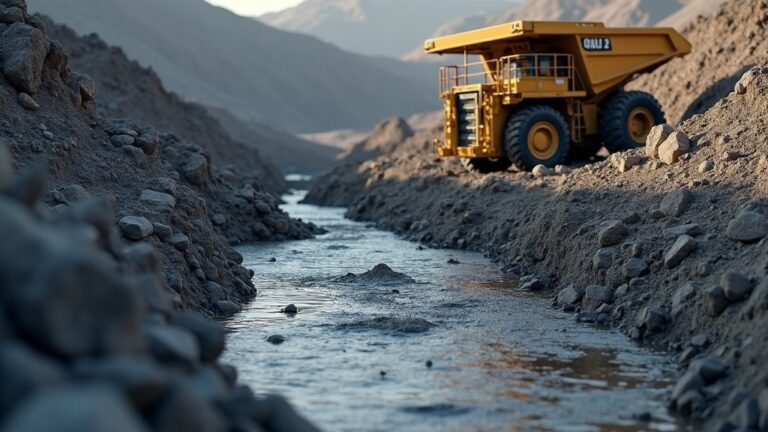
Accurate subsurface modeling is the foundation of any successful tunneling or dam stabilization project. Geological simulation and finite element analysis require immense computational power to map heterogeneous rock faces and predict stress distributions. By utilizing GPU model training, engineers can process seismic and borehole sensor data to create high-fidelity 3D models of the subsurface environment.
“Simulation-first AI training allows us to iterate orders of magnitude faster than in the physical world, which is critical for embodied AI and robotics,” notes Anima Anandkumar, Senior Director of AI Research at NVIDIA (NVIDIA, 2024)[3]. While her focus includes robotics, the exact same principle applies to simulating heavy cutterheads interacting with complex rock mechanics.
This computational approach drastically reduces the uncertainty inherent in underground construction. Instead of relying solely on physical core samples, mining engineers use NVIDIA machine learning to predict fracture networks and groundwater pathways. This ensures that structural support systems and waterproofing membranes are adequately designed before excavation starts, significantly improving safety and efficiency in deep-level mining environments.
Optimizing Grout Injection and Fluid Dynamics
Cementitious grout injection requires precise control over pressure, viscosity, and flow rates to ensure structural stability in mines and tunnels. Computational fluid dynamics simulations are traditionally slow, but accelerated AI workloads have transformed this process. Real-time sensor data from grout pumps can now be fed into predictive models to anticipate how grout will penetrate micro-fractures in the surrounding rock mass.
For more foundational information on these methods, refer to our foundational grouting methods archive. Understanding the baseline physics is crucial before applying advanced algorithms to the mix design.
When grout viscosity changes due to temperature or curing time, the AI model dynamically adjusts pump parameters. This prevents over-pressurization, which could fracture the rock, and under-pressurization, which leads to inadequate sealing. By applying deep learning compute to fluid dynamics, operators achieve a more uniform grout curtain, reducing water ingress and enhancing the long-term durability of the tunnel lining while minimizing material waste.
Predictive Maintenance for Tunnel Boring Machines
Tunnel boring machines represent massive capital investments, making predictive maintenance essential for minimizing costly downtime. These heavy machinery systems generate terabytes of telemetry and sensor data daily. Analyzing this data to predict cutter wear and mechanical failures requires robust neural network optimization to identify subtle degradation patterns.
According to engineering guidelines published by the United States Bureau of Reclamation, continuous monitoring of excavation equipment is vital for large-scale civil engineering projects. Modern AI systems analyze vibration and thermal signatures to flag anomalies long before a catastrophic failure occurs.
To handle this data volume, mining companies deploy powerful hardware. For instance, the DGX H100 system provides up to 32 petaFLOPS of AI performance per node using eight H100 GPUs (NVIDIA, 2024)[4]. This immense processing capability allows site engineers to run continuous inference on live machine data, scheduling maintenance only when necessary and extending the operational life of expensive cutting tools.
Scaling Infrastructure for Heavy Industry AI
Deploying advanced machine learning models in remote mining environments requires robust and scalable computing infrastructure. The hardware must withstand harsh conditions while delivering data center-level performance. Modern GPU clusters are specifically engineered to handle the massive matrices involved in training domain-specific models for industrial applications.
“Blackwell is designed to accelerate generative AI workloads, enabling our customers to train and deploy massive AI models at dramatically lower cost and energy consumption,” states Jensen Huang, Founder and CEO of NVIDIA (NVIDIA, 2024)[1].
Furthermore, efficiency techniques are critical when operating in power-constrained mine sites. “Techniques like mixed-precision training and sparsity are essential to keep pushing the limits of model scale without overwhelming even the most advanced GPU clusters,” explains Bryan Catanzaro, Vice President of Applied Deep Learning Research at NVIDIA (NVIDIA Developer, 2024)[2]. By leveraging tensor cores and optimized software frameworks, mining corporations can train highly accurate models without exceeding their strict energy budgets.
Important Questions About NVIDIA AI Training
How does NVIDIA AI training improve grout penetration predictions?
Can mining companies run these AI models on-site without cloud connectivity?
What is the role of mixed-precision training in geological simulations?
How much data is required to train a predictive maintenance model for a TBM?
Comparing Subsurface Modeling Approaches
Selecting the right modeling approach depends on project scale, data availability, and computational resources. Traditional methods rely heavily on manual interpretation, while modern techniques leverage automated processing to deliver faster results.
| Approach | Speed | Accuracy | Best Use Case |
|---|---|---|---|
| Empirical Formulas | Fast | Low | Preliminary site assessments |
| Physical Scale Models | Slow | Moderate | Complex dam foundation testing |
| NVIDIA AI Training Simulation | Very Fast | High | Real-time TBM and grout optimization |
AI-driven simulation offers the best balance of speed and accuracy for active tunneling operations, allowing for immediate adjustments based on live sensor feedback.
Practical Tips for Implementation
Implementing AI in heavy civil engineering requires careful planning and data management. Follow these best practices to ensure successful deployment:
- Curate High-Quality Data: AI models are only as good as their training data. Ensure sensor data from grout pumps and drilling rigs is clean, synchronized, and properly labeled before beginning the training process.
- Leverage Domain Adaptation: Instead of training large language models or predictive models from scratch, use frameworks designed for fine-tuning. The NeMo framework can reduce the compute required for domain adaptation by up to 75% compared to full retraining (NVIDIA Developer, 2024)[6].
- Start with Edge Inference: Deploy lightweight, pre-trained models to edge devices on the tunnel boring machine first. This provides immediate value and helps build operational confidence before scaling up to full cloud-based training pipelines.
Before You Go
NVIDIA AI training is redefining the boundaries of what is possible in commercial mining and tunneling. By transforming raw telemetry into actionable insights, this technology minimizes risk, optimizes grout injection, and extends the life of heavy machinery. As hardware continues to evolve, the integration of deep learning into civil engineering will only deepen. To see how these advanced technologies are applied in real-world scenarios, review our commercial mining grout injection case studies.
Sources & Citations
- NVIDIA Introduces Blackwell Platform to Power a New Era of Generative AI. NVIDIA.
https://nvidia.com/en-us/news/nvidia-introduces-blackwell-platform-generative-ai - Mixed-Precision Training of Deep Neural Networks. NVIDIA Developer.
https://developer.nvidia.com/blog/mixed-precision-training-deep-neural-networks - How Simulation is Transforming AI Training for Robotics. NVIDIA.
https://blogs.nvidia.com/blog/simulation-ai-training-robotics - NVIDIA DGX H100. NVIDIA.
https://www.nvidia.com/en-us/data-center/dgx-h100 - Pushing the Limits of Large-Scale AI Training. NVIDIA Developer.
https://developer.nvidia.com/blog/large-scale-ai-training-techniques - NVIDIA NeMo Framework. NVIDIA Developer.
https://developer.nvidia.com/nemo-framework