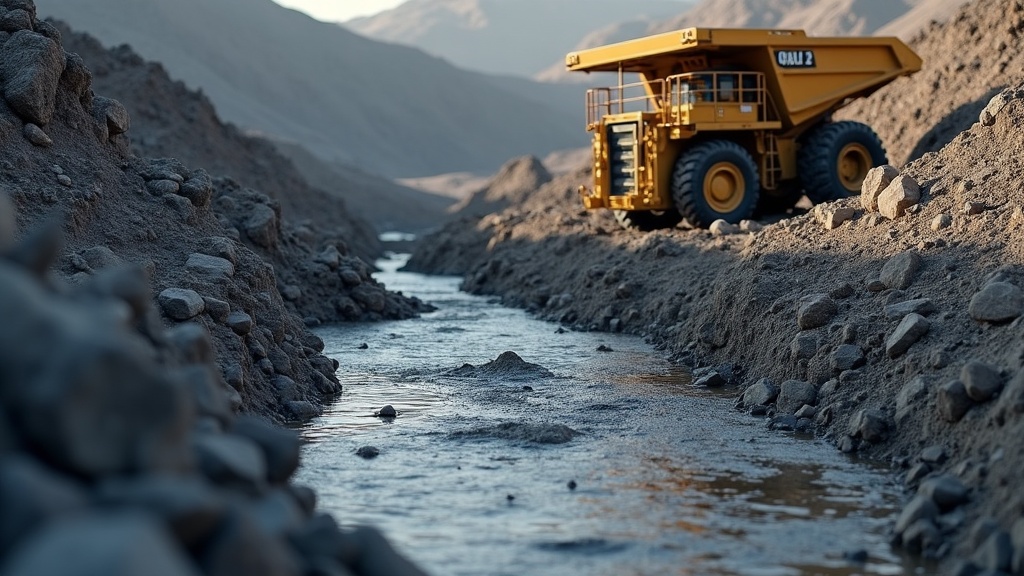
Learn how backfill grouting in mining explained through modern techniques reduces subsidence, stabilizes underground voids, and improves safety in coal and metal mining operations.
Table of Contents
- Introduction
- Key Backfill Grouting Techniques for Underground Mines
- Materials Used in Backfill Grouting Operations
- Subsidence Control and Structural Benefits
- Design and Implementation Considerations
- Frequently Asked Questions
- Comparison of Backfill Grouting Methods
- Practical Tips for Backfill Grouting Projects
- Final Thoughts on Backfill Grouting in Mining
- Useful Resources
Quick Stats: Backfill Grouting in Mining
- Fly ash slurry backfill grouting achieved a filling rate of 43.46% in an advancing coal mining panel while controlling strata movement (Advancing Coal Mining Fly Ash Slurry Backfill Grouting study, 2024)[1]
- Surface subsidence above the panel where fly ash slurry backfill grouting was applied was reduced by 40.63% compared with non‑grouted conditions (Advancing Coal Mining Fly Ash Slurry Backfill Grouting study, 2024)[1]
- A deep mine backfilling project at Wabash Valley Correctional Institution injected 9,559 cubic yards of cement‑fly ash‑sand grout into abandoned mine workings (Marino Engineering Associates project bulletin, 2025)[2]
Introduction
Backfill grouting in mining explained begins with a simple premise: after valuable ore or coal is extracted, the empty void left behind can cause catastrophic ground instability if left unfilled. The process involves pumping a flowable grout mixture – often composed of cement, fly ash, sand, and water – into mined-out cavities to create a solid mass that supports the surrounding rock mass. This technique has become indispensable for modern underground operations, particularly in advancing longwall coal panels and deep metal mines where surface subsidence must be tightly controlled.
The practice of backfill grouting serves multiple purposes simultaneously. It stabilizes the mine roof and floor, reduces the risk of sudden collapses, and allows for safer extraction of adjacent reserves. Moreover, it addresses environmental concerns by utilizing industrial byproducts such as coal combustion fly ash, which might otherwise be landfilled. As mining operations extend deeper and into more populated areas, the demand for reliable void stabilization methods has grown significantly. This article covers the core techniques, materials, design principles, and practical benefits of backfill grouting in mining, drawing on recent research and field case studies.
Readers will find a detailed comparison of hydraulic flushing versus point-source grouting, an overview of the most common grout formulations, and actionable advice for planning a successful backfill program. For a broader introduction to the topic, refer to the backfillgrouting guide available on our site.
Key Backfill Grouting Techniques for Underground Mines
The selection of a backfill grouting technique depends on the geometry of the void, the geological conditions, and the project’s primary objectives – whether subsidence control, roof stabilization, or tailings disposal. Two principal methods dominate the industry: hydraulic flushing and point-source grouting.
Hydraulic Flushing
Hydraulic flushing involves transporting a high-volume slurry through boreholes or pipes directly into the void, where the solids settle and the water is drained or recirculated. According to the U.S. Bureau of Mines, hydraulic flushing had historically been used in the majority of abandoned mine backfilling cases, accounting for more than 70% of documented stabilization efforts (State-of-the-Art Techniques for Backfilling Abandoned Mine Voids, 2024)[3]. This method is particularly effective for large, interconnected voids where rapid filling is desired. However, it requires a reliable water supply and a system for managing excess water.
Point-Source Grouting
Point-source grouting, in contrast, targets specific areas of instability by injecting grout under pressure to form discrete columns or plugs. As mining engineer David C. Oyler noted, “Grouting is most effective when used as a point‑source method to form grout columns that transfer load from the mine roof to the floor, thereby stabilizing critical areas” (State-of-the-Art Techniques for Backfilling Abandoned Mine Voids, 2024)[3]. This approach is highly efficient for localized reinforcement, such as beneath building foundations or roadways. It often requires less total grout volume than hydraulic flushing but demands precise drilling and injection control.
Paste and Cemented Backfill
A third category, paste backfill, mixes the tailings with a binder (usually cement) to create a high-density, non-segregating slurry that is pumped into stopes. This method is common in metal mines where the backfill must provide both immediate ground support and a working platform for subsequent mining. Modern backfill technology integrates hydraulic and paste grouting techniques to simultaneously stabilize excavations, dispose of tailings, and minimize environmental impacts, as described by Manuel Eisner (State of the art of backfill technology in underground mining, 2025)[4].
Materials Used in Backfill Grouting Operations
The choice of grout material directly influences the cost, strength, and environmental footprint of a backfill project. The most common binders are Portland cement and fly ash, often combined with sand or crushed rock to achieve the desired rheology and strength.
The U.S. Bureau of Mines identified three major industrial waste streams suitable for use as mine backfill grout components: pulverized coal combustion fly ash, flue gas desulfurization by‑products, and fluidized bed combustion residue (Utilization of coal combustion byproducts as mine backfill materials, 2024)[5]. These materials are not only cost-effective but also address waste disposal challenges. In the Wabash Valley project, a cement‑fly ash‑sand mixture was injected at a volume of 9,559 cubic yards, demonstrating the scalability of these blends (Marino Engineering Associates project bulletin, 2025)[2].
Professor Peter K. Kaiser emphasized that “the design of cemented backfill and grouting systems must consider not only strength but also stiffness, since the control of deformation is critical to ground stability in underground mining” (Journal of Rock Mechanics and Geotechnical Engineering, 2025)[6]. Numerical modelling studies indicate that increasing backfill stiffness by 25–30% can reduce stope closure and wall convergence by approximately 15–20% (Journal of Rock Mechanics and Geotechnical Engineering, 2025)[6]. This underscores the importance of tailoring the mix design to the specific mechanical requirements of the mine.
For operations interested in optimizing their material selection and placement strategies, exploring machine learning and AI training for backfill design can provide advanced predictive capabilities for grout performance.
Subsidence Control and Structural Benefits
The primary driver for backfill grouting in many projects is the mitigation of surface subsidence. When a void is left unsupported, the overlying strata can fracture and sink, causing damage to buildings, pipelines, and roads. Backfill grouting provides a mechanical barrier that transfers load from the roof to the floor, reducing the magnitude of surface deformation.
Quantitative evidence from a recent study on advancing coal mining panels demonstrates the effectiveness of this approach. Fly ash slurry backfill grouting achieved a filling rate of 43.46% while controlling strata movement, and surface subsidence above the panel was reduced by 40.63% compared with non‑grouted conditions (Advancing Coal Mining Fly Ash Slurry Backfill Grouting study, 2024)[1]. These figures highlight that even partial void filling can yield substantial subsidence reductions.
Gennaro G. Marino, President of Marino Engineering Associates, noted the economic advantage: “In many undermined sites, deep mine backfilling and grouting is significantly more cost‑effective than designing surface structures to be subsidence‑resistant” (Successful Deep Mine Backfilling to Mitigate Mine Subsidence, 2025)[2]. This cost-benefit ratio makes backfill grouting an attractive option for mitigating risk over large areas. Furthermore, case studies report that targeted point‑source grout columns can increase localized roof support capacity by factors of 2 to 3 compared with ungrouted conditions (State-of-the-Art Techniques for Backfilling Abandoned Mine Voids, 2024)[3], providing a safety margin that is difficult to achieve with other methods.
Design and Implementation Considerations
A successful backfill grouting program requires careful planning across several domains: geological assessment, borehole layout, grout mix design, and quality control. The first step is a thorough investigation of the void geometry and the condition of the surrounding rock. This often involves drilling exploratory boreholes and performing geophysical surveys to map the extent of the mine workings.
Borehole placement is critical for both hydraulic flushing and point-source grouting. In the Wabash Valley project, 41,349 linear feet of drilling was required to place containment and infill grout (Marino Engineering Associates project bulletin, 2025)[2]. This drilling network allowed for systematic injection, ensuring that grout reached all targeted zones. The spacing and depth of boreholes must be optimized to avoid over-grouting or leaving untreated gaps.
Grout mix design must balance pumpability, setting time, and final strength. For large-volume projects, a low-cost binder like fly ash is often preferred, with cement added only where higher early strength is needed. The rheology of the slurry must be monitored continuously to prevent blockages and ensure uniform filling. Additionally, environmental regulations may require testing of grout leachate to prevent contamination of groundwater.
Quality control involves taking core samples of the set grout and conducting pressure tests to verify that the void has been adequately filled. In metal mines where backfill volumes can reach 50–60% of total void space (Montanuniversität Leoben, 2025)[4], the economic viability of the operation depends on efficient placement and minimal waste.
Important Questions About Backfill Grouting in Mining
What is the difference between backfill grouting and regular grouting?
Backfill grouting in mining is specifically designed to fill large underground voids created by excavation, such as stopes or longwall panels, with the primary goal of ground stabilization and subsidence control. Regular grouting, in contrast, typically involves injecting smaller volumes of grout to seal cracks, fill joints, or anchor bolts in rock or concrete. The scale, material volumes, and placement methods differ significantly. Backfill grouting often utilizes industrial byproducts like fly ash in high volumes, while regular grouting usually relies on neat cement or chemical grouts for precision applications.
How long does a backfill grouting project take to complete?
The duration of a backfill grouting project varies widely based on the size of the void, the number of boreholes, and the grouting method employed. A small point-source grouting operation to stabilize a localized subsidence zone might be completed in a few days, while a large-scale hydraulic flushing project for an abandoned mine complex could take several months. The Wabash Valley project, for example, involved drilling 41,349 linear feet of boreholes and injecting 9,559 cubic yards of grout, which required a sustained effort over multiple phases. Detailed planning and continuous monitoring are essential to keep the project on schedule.
Is backfill grouting environmentally safe?
When properly designed and executed, backfill grouting can be environmentally beneficial. The use of industrial byproducts such as fly ash and flue gas desulfurization residues reduces the need for landfill disposal of these materials. However, the grout mixture must be tested to ensure that it does not leach heavy metals or other contaminants into groundwater. Regulatory permits typically require a leachate analysis and a groundwater monitoring plan. The primary environmental benefit is the prevention of surface subsidence, which protects ecosystems, water drainage patterns, and existing infrastructure.
Can backfill grouting be used in both coal and metal mines?
Yes, backfill grouting is applied in both coal and metal mining operations, although the techniques and materials may differ. In coal mining, the focus is often on controlling subsidence from longwall panels, using fly ash slurries or cementitious grouts. In metal mines, backfill grouting is frequently integrated with the stoping sequence to provide a stable working platform for the next level of extraction. Paste backfill, which uses the mine’s own tailings as aggregate, is particularly common in metal mines. The principles of void filling and ground support apply across both sectors.
Comparison of Backfill Grouting Methods
Choosing between hydraulic flushing and point-source grouting requires evaluating project-specific factors such as void geometry, required strength, and budget. The table below summarizes the key differences between the two primary approaches.
| Feature | Hydraulic Flushing | Point-Source Grouting |
|---|---|---|
| Primary Application | Large, interconnected voids | Localized unstable zones |
| Grout Volume | High (thousands of cubic yards) | Low to moderate |
| Water Management | Significant; requires drainage | Minimal; grout stays in place |
| Drilling Requirements | Fewer, larger-diameter boreholes | Many, smaller-diameter holes |
| Subsidence Control | Broad area coverage | Targeted load transfer |
| Cost per Cubic Yard | Lower | Higher |
Practical Tips for Backfill Grouting Projects
Executing a successful backfill grouting program requires attention to detail from the planning stage through to final verification. The following actionable tips are drawn from industry best practices and recent case studies.
- Conduct a thorough site investigation. Before any grout is mixed, map the void geometry using geophysical methods and exploratory drilling. Understanding the extent of the mine workings prevents under- or over-filling and reduces the risk of grout escaping into unwanted areas.
- Optimize the grout mix for the specific application. For subsidence control projects where strength is secondary to volume, a high fly ash content mix is cost-effective. For structural support in active stopes, increase the cement content and consider additives to control setting time and shrinkage.
- Implement real-time monitoring. Use pressure gauges, flow meters, and ground-motion sensors during injection. This data allows operators to adjust the grouting parameters on the fly and to detect anomalies such as grout loss into fractures. Post-grouting verification with core drilling or geophysical surveys confirms that the void has been adequately filled.
For teams looking to deepen their expertise, the ai training online resource provides valuable insights into modern analytical approaches for mining applications.
Final Thoughts on Backfill Grouting in Mining
Backfill grouting in mining explained through this article demonstrates its vital role in modern underground operations. By filling voids with engineered grout mixtures, mining engineers can control subsidence, stabilize excavations, and improve safety while often reducing the environmental footprint of waste materials. The documented success of projects using fly ash slurries and cementitious grouts provides a strong evidence base for the technique’s effectiveness. As mining continues to move deeper and into more sensitive environments, the importance of reliable backfill grouting will only grow. For further reading on related topics, explore our resources on grouting applications in tunneling and mining.
To learn more about how these techniques can be applied to your specific project, visit our main site for detailed case studies and technical guides.
Useful Resources
- Advancing Coal Mining Fly Ash Slurry Backfill Grouting. Scribd.
https://www.scribd.com/document/870308363/Advancing-Coal-Mining-Fly-Ash-Slurry-Backfill-Grouting - Successful Deep Mine Backfilling to Mitigate Mine Subsidence. Marino Engineering Associates.
https://meacorporation.com/wp-content/uploads/project-bulletin-01.pdf - State-of-the-Art Techniques for Backfilling Abandoned Mine Voids. U.S. Bureau of Mines.
https://stacks.cdc.gov/view/cdc/206318/cdc_206318_DS1.pdf - State of the art of backfill technology in underground mining. Montanuniversität Leoben.
https://pure.unileoben.ac.at/ws/portalfiles/portal/2402127/AC12252913n01vt.pdf - Utilization of coal combustion byproducts as mine backfill materials. U.S. Bureau of Mines.
https://stacks.cdc.gov/view/cdc/235651/cdc_235651_DS1.pdf - Design aspects of cemented backfill for underground mines. Journal of Rock Mechanics and Geotechnical Engineering.
https://www.sciencedirect.com/science/article/pii/S1365160914002539